
Website Traffic Strategy: What Happens After the Click?
Website traffic strategy is one of online marketing’s favorite focuses. Website visits, ad clicks, video impressions, and social media reach are easy to count, so they are easy to celebrate.
Yet, from an operational and commercial standpoint, raw visitor volume is vanity. Ten thousand visitors who leave without engaging, reading, or acting are far less commercially valuable than five hundred visitors who arrive with the right expectations and take a decisive next step.
Online marketing often treats traffic as an achievement. In reality, traffic is simply activity. To build a commercially viable business, treat traffic as one component of an end-to-end commercial process. Before traffic reaches your website, you must answer another question: is the message appearing in the right place?
What Is Traffic Actually Supposed to Do?
Traffic has one distinct mechanical purpose: to move someone from one environment to another.
- A targeted search result moves someone from Google to an in-depth guide.
- A contextual social post moves someone from a crowded feed to a focused editorial page.
- An email newsletter moves an engaged subscriber to a specific recommendation or service.
- A paid advertisement moves a prospect with a defined problem to a tailored solution.
Most website traffic strategy discussions start by asking: “How do we get more traffic?”
A practical, outcome-driven framework asks the reverse: “What do we need this person to do when they arrive?”
If you don’t know the answer, buying media or chasing search traffic only accelerates waste.
A Click Is a Handover
A click is never the finish line. It is an operational handover.
When someone views an advertisement, search snippet, or social post, that media makes an implicit promise. It sets a specific expectation in the visitor’s mind. The click transfers that expectation to the destination page.
Message ──▶ Click ──▶ Destination ──▶ Response
If a visitor clicks an ad promising practical advice on managing startup cash flow and lands on a generic homepage shouting about corporate awards, the marketing chain breaks instantly. The destination must seamlessly continue the conversation started by the media—not force the visitor to restart it.

Not All Website Traffic Strategy Approaches Have the Same Value
Counting visits tells you how many people arrived, but nothing about why.
Different traffic channels arrive carrying vastly different levels of intent:
- High-Intent Search Traffic: A user searching a specific query (e.g., “how to calculate inventory turnover”) arrives actively seeking a concrete solution.
- Low-Intent Social Traffic: A user browsing an algorithmically generated feed is interrupted. They clicked out of casual curiosity, not an urgent commercial need.
- Direct Email Traffic: A subscriber already knows, trusts, and understands your baseline message. Their threshold for action is significantly lower.
- Google has documented how people can move through multiple search and digital touchpoints while researching and making decisions.
Treating all clicks as equal units of value distorts commercial planning. Quality, intent, and alignment consistently outperform sheer volume. For example, SaaS companies like Basecamp have famously grown by focusing on onboarding and activation rather than just driving massive traffic, proving that aligning post-click experiences with visitor intent delivers stronger business outcomes.
Understanding what people actually want helps explain why two visitors arriving at the same page may have completely different reasons for being there.
What Happens in the First Few Seconds?
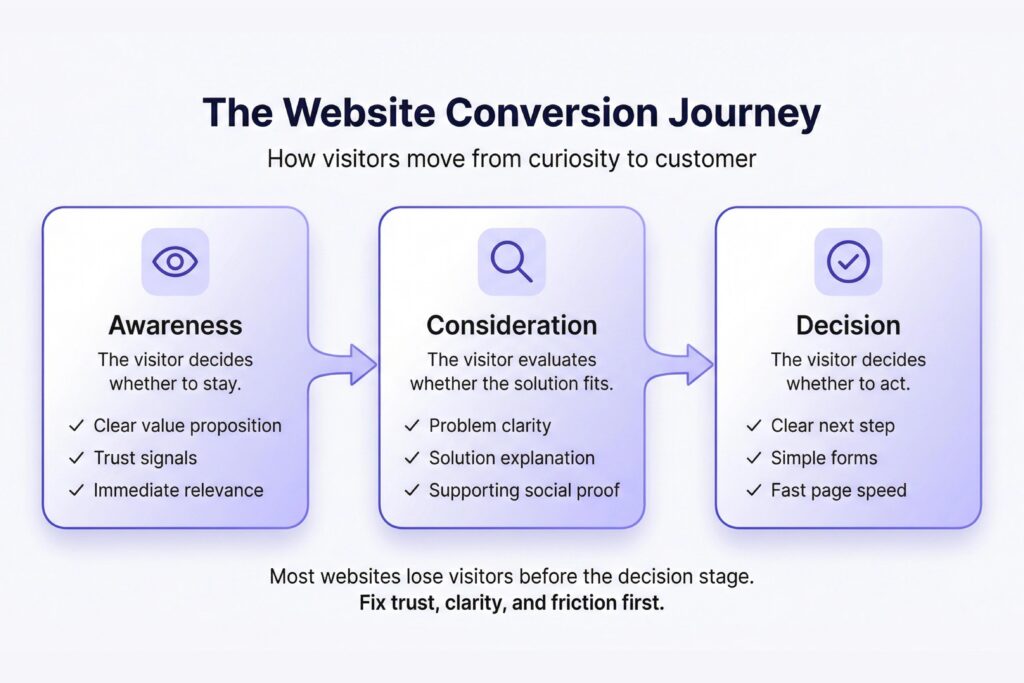
The moment a visitor lands, their subconscious evaluates the page through a rapid filter of self-interest (What’s In It For Me):
- Am I in the right place? Does the headline immediately match the language of the link I clicked?
- Is this what I expected? Does the layout look credible, clean, and relevant to my query?
- Is there something useful here for me? Can I see an answer or path forward within seconds, or am I buried under pop-ups and fluff?
- What do I do next? Is the subsequent step obvious, intuitive, and frictionless?
If the page fails to answer these questions immediately, the visitor leaves. No amount of traffic optimization can rescue a destination page that lacks immediate clarity.
Once someone arrives, the page must present its value clearly enough for the visitor to understand why continuing is worthwhile.
Every Page Needs a Purpose in Your Website Traffic Strategy
A meaningful response does not have to be an immediate credit card transaction. Depending on where the visitor sits within the broader journey, different pages serve distinct functions:
- An Educational Guide: Designed to direct the reader to a related, deeper resource.
- A Category or Hub Page: Designed to encourage structured exploration.
- A Case Study or Review: Designed to help a prospect evaluate a specific method or tool.
- A Resource Landing Page: Designed to exchange a practical asset for direct contact details.
- A Sales Page: Designed to secure an order or application.
The core discipline is ensuring every page has a defined, singular role. If a page has no clear next step, it serves no commercial function. For ecommerce, this might mean recommending related products; for B2B, offering a downloadable case study; for SaaS, prompting a free trial; for content publishers, inviting to subscribe. Tailor next steps to your business model.
Website Traffic Strategy Without a Next Step Becomes a Dead End
One of the most expensive errors in digital publishing and advertising is spending significant resources driving visitors to an article or page that stops.
- No contextual internal links.
- No suggested reading.
- No clear invitation to subscribe.
- No relevant offer or next step. No segmentation based on visitor type or source, such as offering more in-depth guides to high-intent visitors and lighter content to casual browsers.
When visitors reach the end of your content and find silence, they leave. That is not a failure of the traffic channel; it is a breakdown of the visitor journey.
Response Is Where Traffic Becomes Meaningful
Within a complete operating system, media merely delivers the prospect. The Response phase proves whether the message hit its mark.
Market ──▶ Message ──▶ Media ──▶ Response
Response encompasses any measurable, deliberate progress along the journey:
- Reading a follow-up article.
- Subscribing to an ongoing publication.
- Downloading a diagnostic checklist or framework.
- Requesting direct consultation.
- Initiating a trial or completing a purchase.
Without a designed response mechanism, traffic is just an operational cost. Use tactical elements like strong calls-to-action (CTAs), contextual internal links, and clear landing page design to guide visitors toward meaningful responses.
Measure What Matters
Focusing on traffic alone answers a superficial question: Did people arrive?
Evaluating the response answers the commercial question: What happened because they arrived?
Measuring real marketing performance begins here. Go beyond traffic volume and monitor metrics like conversion rate, bounce rate, and average session duration using tools like Google Analytics or Hotjar.
Before worrying about complex attribution models or analytics dashboards, establish the baseline: did the visitor take the logical, intended step after the click?
Before investing budget, time, or editorial effort into acquiring more visits, define the handover. Know precisely what conversation the media starts, and what practical step the destination must prompt.
Traffic is not the goal. A successful website traffic strategy recognizes that traffic merely creates the opportunity for a response.